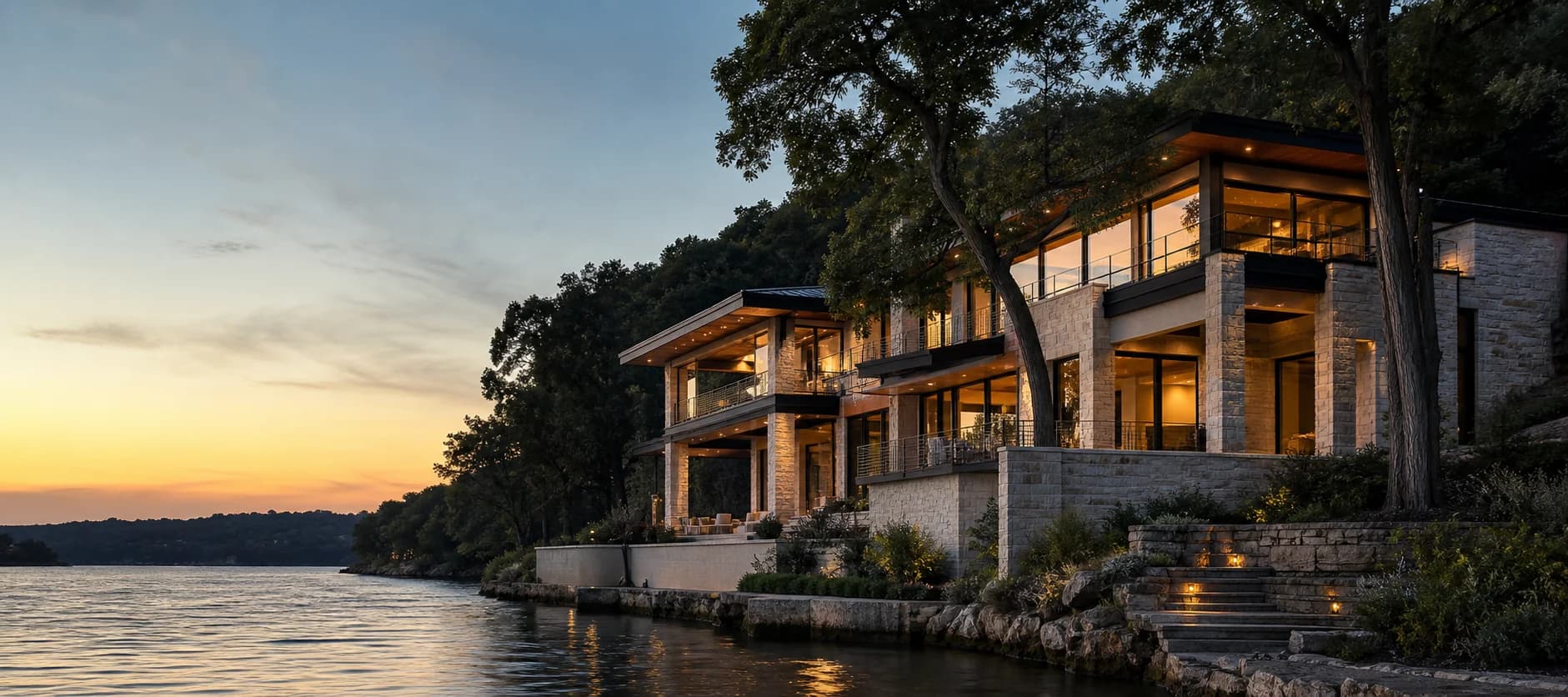
Reading the Water Before the House
A working framework for evaluating Lake Austin waterfront: why frontage, depth, position and the path to the shoreline deserve attention before the residence does.

Two Lake Austin homes can read identically on paper and live completely differently. The listing language is the same: waterfront, private dock, sweeping views. The experience, and the value, can be far apart. The difference is almost always in the water, not the house.
Start with frontage, not finish
Frontage width sets the ceiling for everything else: how a dock can be positioned, how much separation exists from neighboring structures, and how the shoreline can be used day to day. A narrow lot with an exceptional residence will still live like a narrow lot.
Before the interior walk-through, it is worth understanding three measurements:
- Usable frontage at the waterline, as distinct from the recorded lot width.
- Water depth at the dock across seasons and lake-management cycles.
- Setbacks and easements that limit where structures can sit along the shore.
Position changes the daily experience
A cove and the main basin offer different lives. Coves tend to be quieter, with less wake and more privacy, but can carry trade-offs in depth or sun exposure. Main-basin positions offer the long view and open water, with more boat traffic in exchange.
Neither is better in the abstract. The question is which trade-off suits the principal, and whether the asking price already reflects it.
The path to the water is part of the asset
Bluff properties often carry the most dramatic views and the most complicated access. A tram, a long stair, or an engineered descent is not a detail. It shapes how often the water is actually used, what the structure costs to maintain, and how a future buyer will see the property.
The value of waterfront is the value of using it. A shoreline reached twice a summer is a view, not a waterfront.
Separate the water from the structure
The central analytical task on Lake Austin is to price the land and the water independently of the residence. An older home on wide, deep frontage may be the stronger long-term position. A newer build on a compromised site may be the weaker one, however well it presents.
That discipline is what allows a principal to decide clearly: renovate, replace, or walk away.
Frequently asked
- Is wider frontage always more valuable than a larger residence?
- Not always, but it is the more durable of the two. A residence can be rebuilt; frontage cannot be manufactured. In most comparisons the water carries the larger share of long-term value.
- What should be verified about a dock before an offer?
- Its permitting status with the LCRA, the water depth at the slip across seasons, and whether the structure as built matches what was approved. Discrepancies are common and belong in the negotiation.